
Arrest Warrants in Platte County
Under Nebraska law, an arrest warrant starts with a written complaint and a probable-cause showing before a judge or magistrate. The Nebraska Judicial Branch walks through each step: the complaint, the sworn affidavit, the probable-cause finding, the signed warrant, and filing with the county-court clerk. In Platte County, the county court is the practical first stop on the preliminary path, and felony cases move on to District Court for trial. The sheriff's weekly warrant list may carry a short charge label, but it does not publish the complaint or the warrant itself. Its landing page warns against making an arrest based on the list, and it gives 402-564-3229 for confirmation. Call first. The court file, not the PDF, is the record that counts.
Platte County Probable-Cause Path
The local record path is easier to understand as a sequence: complaint or affidavit → probable-cause review → signed warrant → clerk filing → service or return → first appearance and release order. The exact case stage can vary. The public should use the court file and current docket rather than infer the stage from a weekly list row.
The state's pretrial explanation lays out the complaint and probable-cause sequence in plain terms, and it sorts county-court misdemeanor and traffic work from felony proceedings. A Platte County warrant record can hold far more than the public PDF: the complaint, the affidavit, the charge, the judge or magistrate, the issue date, register entries, and public images where available. The official page spells all of this out.
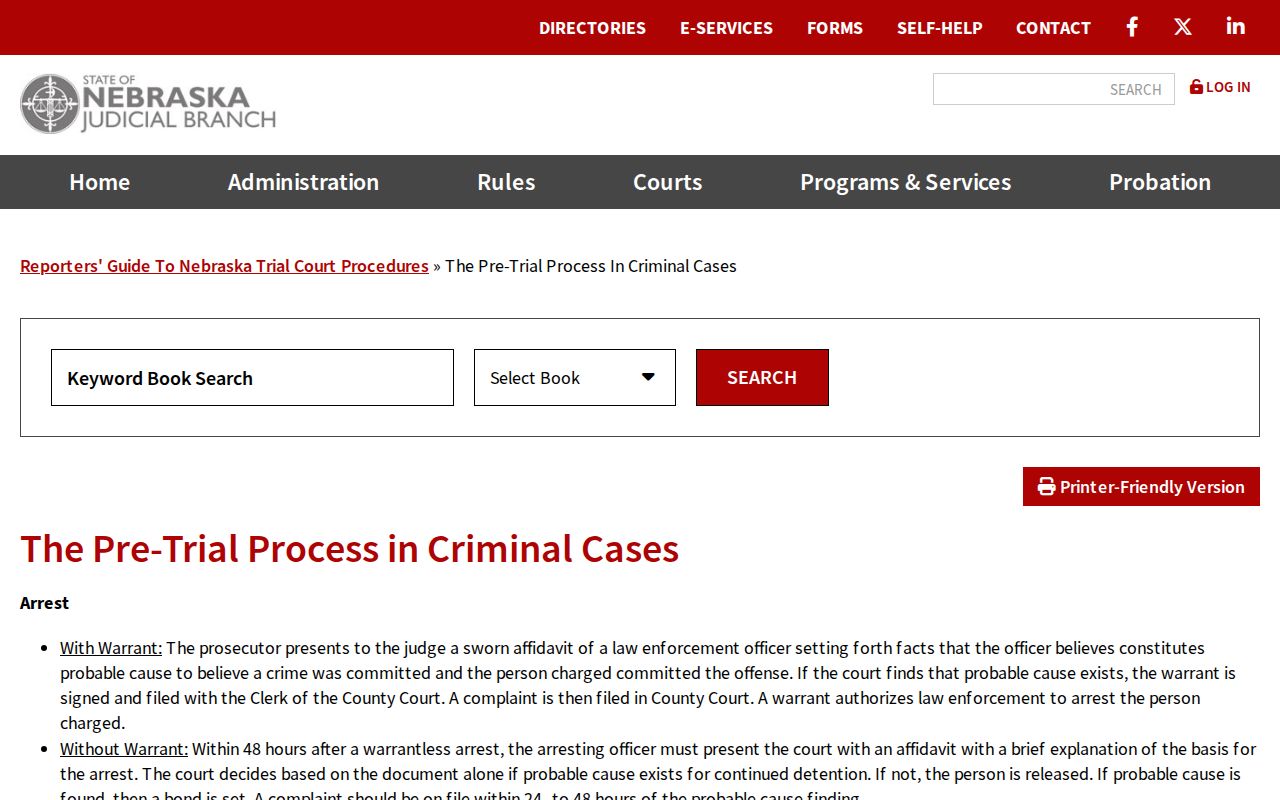
The affidavit source makes one thing clear. A Platte County case file and a weekly list are not the same record.
What a Platte County Arrest Warrant Contains
Nebraska section 29-406 directs an arrest warrant to a sheriff, a city or village marshal, or a police officer, and it requires the warrant to recite the substance of the complaint. A public case request in Platte County can ask for that document and the related docket entries, subject to access rules. The sheriff PDF is no substitute for the papers themselves.
| Case number | The court identifier linking the warrant to its file. Use a redacted form such as CR-#### in public explanations. |
|---|---|
| Complaint or charge | The written accusation or offense entry used in the probable-cause path. |
| Issuing court | The court whose judge or magistrate reviewed the process. |
| Issue date | The date the warrant was signed or entered, distinct from service. |
| Return or service | A later entry showing what happened with execution or return. |
| Bond or release order | The current judge-set condition, not a field in the weekly sheriff PDF. |
Ask the Platte County clerk what is public and what the register shows. Case files can carry private identifiers that belong in the court's hands, not in yours.
How Platte County Arrest Warrants Are Served
Nebraska section 29-407 lets a warrant be executed anywhere in the state, and other officers can be called on for help. Serving arrest warrants is listed among the Platte County Sheriff's duties. Columbus Police and other authorized agencies may serve process too, within their authority or under an interlocal arrangement. A private reader has no role in executing a warrant.
A row on a Platte County list is not a license to confront anyone. Confirm through the sheriff or the court, and reserve 911 for emergencies.
Arrest Warrant Versus Summons
A summons orders a person to appear, without the immediate arrest power a warrant carries. A bench warrant comes from a judge after an appearance, payment, or order problem, while an arrest warrant follows a complaint and a probable-cause finding. In Platte County, the document and the docket control. A casual label on a list does not.
| Document | Typical purpose | Record to confirm |
|---|---|---|
| Arrest warrant | Authorizes arrest after probable-cause review | Complaint, affidavit, signed warrant, return, bond |
| Summons | Commands appearance without the same immediate arrest function | Notice, date, case number, issuing court |
| Bench warrant | Responds to a missed appearance, nonpayment, or contempt issue | Court order, FTA or contempt entry, remedy |
If a Platte County record is unclear, ask the issuing clerk which document is on file. Also ask whether a current appearance date or bond instruction applies.
What the Platte County PDF Omits
The weekly PDF shows four fields: Name, Case #, Charges, and Date of warrant. What it leaves out matters just as much. No probable-cause affidavit, no judge, no bond, no status, no service return, and no DOB, address, physical description, or photograph. Nebraska JUSTICE can fill in some of the picture with a case summary, offense details, a register of actions, financial information, and public images where available, though it carries its own lag and access limits. None of that gap is your fault. It simply means using the right channel. A Platte County list is a publication snapshot. The complaint and the order live in the court file, and service questions belong with the sheriff's confirmation.
Platte County Arrest-Warrant Bond
Bond and release conditions come from the judge's order. Nebraska's initial-appearance materials describe personal recognizance, percentage or 10% bond, financial ability, and pretrial conditions, and the state skips the commercial bail-bondsman model common elsewhere. The detention page says a person who does not bond may go before a judge within 24 hours. Be careful with payment channels in Platte County. The county-linked remote portal handles payments, not status checks, and it demands sensitive defendant and inmate fields. Nebraska ePayments states plainly that bond payments are not allowed online. Ask the detention facility and the court which channel fits the order.
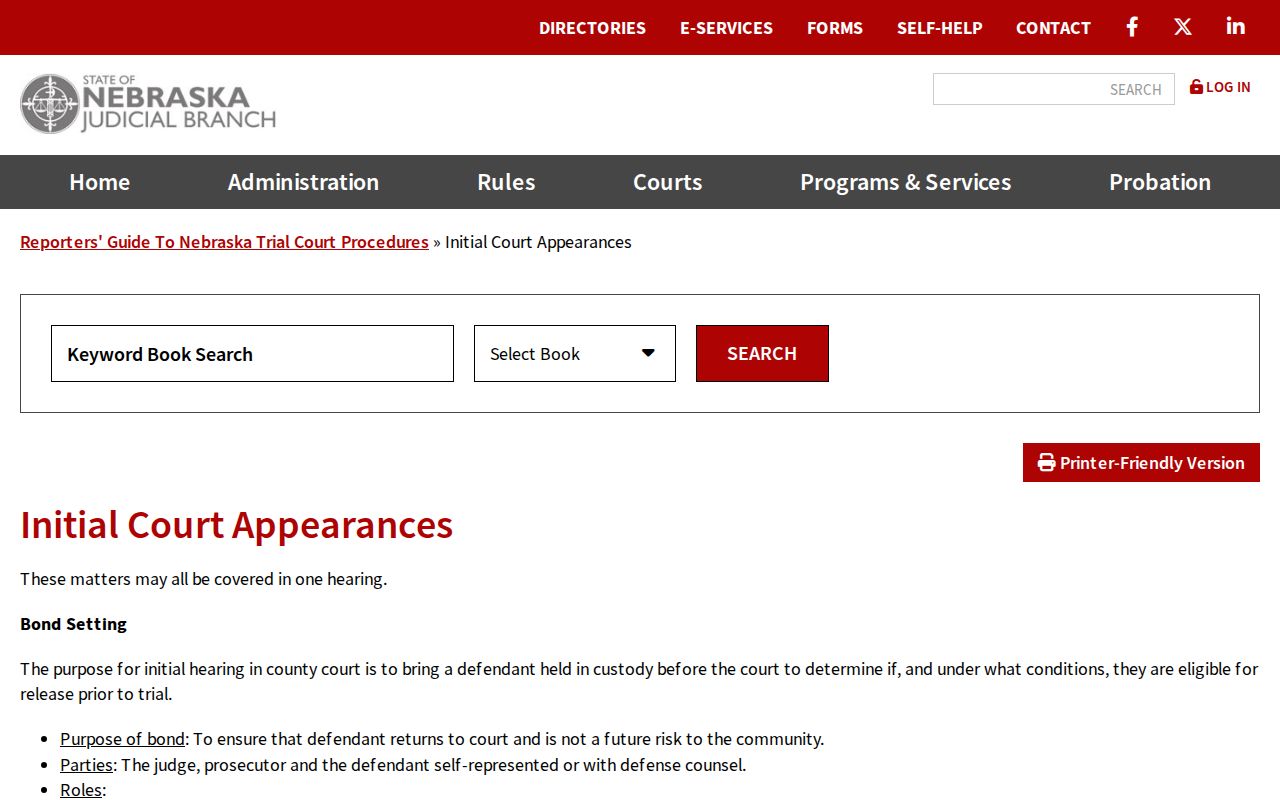
The official first-appearance source explains bond types without predicting what any Platte County judge will order.
Arrest Warrant and Booking
After an arrest, the Platte County Detention Facility describes property intake, medical screening, fingerprinting, photographing, and a warrants check. Timing varies with facility volume and with what state and national databases return. A person who does not bond may see a judge within 24 hours, per the facility's own description. Booking is not a court finding. The charge, the bond, and the release terms come from the court order and the docket. Family members should call the official detention number, never a number an incoming caller supplies.
What to Do If There Is a Warrant
Start with the issuing court. Ask its clerk what step must happen before you appear on a Platte County warrant. No office here publishes a walk-in surrender schedule, a same-day recall promise, or one flat motion fee. What the file requires could be an attorney, a motion, a hearing, bond, or another instruction from the court itself.
Use official channels: Nebraska courts warn that arrest warrants are not served by phone, text, or email. End a pressured call and independently find the court, sheriff, or detention number.
A missed court date or an unpaid ticket changes the math. An online ticket payment does not always recall the warrant. The Platte County warrant overview puts the court, sheriff, detention, and access routes side by side.
Public Arrest-Warrant Access
Nebraska Public Records Statutes generally open public records to anyone. Law-enforcement files, juvenile matters, sealed cases, and other protected records still carry limits. So ask the Platte County office that holds the item for an identified complaint, a warrant document, a docket entry, or a date range. Keep the request specific. The District Court does not conduct criminal-record searches, so seek inspection of a known public record rather than a new bulk search.
Relevant law: section 29-404 covers complaint and probable cause, section 29-406 addresses the warrant’s direction and substance, and section 84-712.05 lists access exceptions.
If anything is withheld, ask for the segregable nonexempt portions and the statutory basis. Platte County requesters should keep private names, birth dates, addresses, and photos out of any public reference.